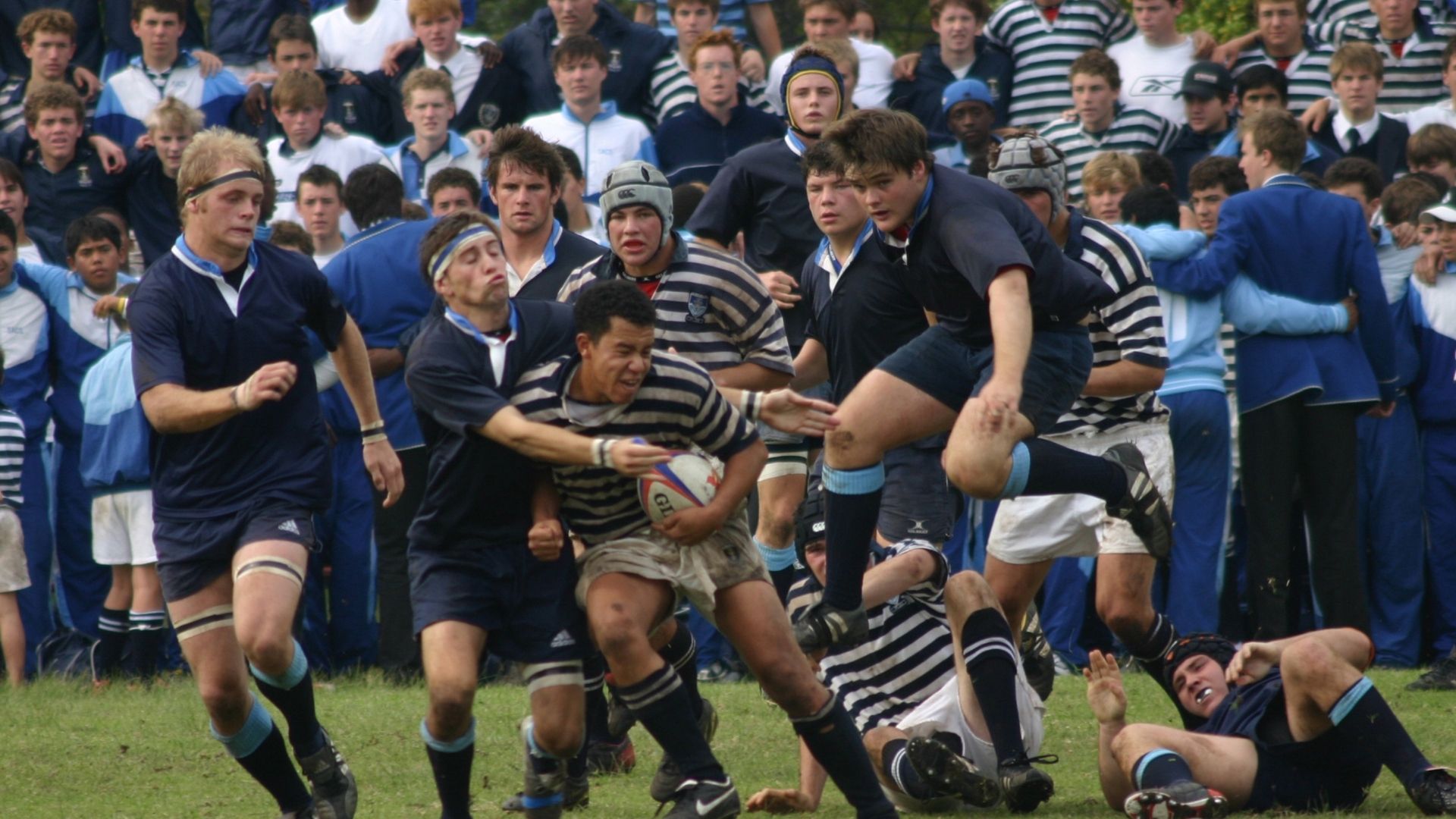
The jump from primary school rugby to high school rugby is one of the biggest transitions a young player will make in their sporting life. The game gets faster, the physicality increases significantly, and the gap between players who continue to develop and players who plateau becomes visible quickly. By the time first team selection comes around at U16 or U18 level, the players who have put in individual development work outside of squad training are almost always the ones who stand out.
At IBIC Rugby, I coach high school players across the Southern Suburbs of Cape Town on exactly this transition, and the same themes come up consistently at each level. This post covers what players should be prioritising at U14, U16, and U18 and why individual coaching makes a meaningful difference at each stage.
What Changes When You Move from Primary School to High School Rugby
At primary school level, the game is largely about developing basic skills in a fun and age-appropriate environment. Body size differences between players are managed carefully, contact is introduced progressively, and the emphasis is on enjoyment and foundational technique. By the time a player moves into high school rugby, the game is unrecognisable in its physical demands.
Tackles are harder, rucks are more contested, set pieces carry real tactical weight, and the expectation from coaches shifts from participation to performance. Players who arrive at high school with solid foundational skills pick up the new demands quickly. Players who arrive with gaps in their technique find those gaps exposed very early, and without individual attention to address them, those gaps tend to widen rather than close over time.
The challenge for high school coaches is the same one that exists at all levels of squad coaching. With 30 or more players in a squad, the available time for individual skill development is minimal. Practices focus on team patterns, set piece preparation, fitness, and match preparation. There is simply not enough time to work individually on one player’s defensive alignment, another player’s kicking technique, and a third player’s breakdown work, all in the same session.
Individual coaching outside of squad training fills exactly this gap, and at high school level the impact of that individual work is compounded by the fact that players are physically developing rapidly and are highly receptive to technical improvement when it is delivered with focused attention.
U14 — Building the Physical and Technical Foundation
At U14 level, the most important thing a player can work on is their physical technique in contact situations. This is the age at which the physicality of the game increases most sharply, and players who have not developed correct body position, low body height in contact, and safe tackle and ball-carrying technique are both at greater risk of injury and at a competitive disadvantage against players who have.
BokSmart principles are central to how I approach all contact work at this level, regardless of how physically developed a player might be. Safe technique is always the foundation before intensity is added.
Beyond contact, U14 is also the level at which players begin to develop a position identity. A player who has played in the backs at primary school level starts to become a specific type of back, with the skills and responsibilities that come with that position. The same is true for forwards. Individual coaching at U14 allows players to begin developing position-specific skills in a focused environment rather than only learning them in the context of team practice, where the pace of the session rarely allows for the kind of repetition that makes a technical skill truly reliable under pressure.
U16 — Position Specificity and Competitive Development
By U16, first team selection is on the horizon and the competition within squads intensifies. This is the level at which the difference between a talented player and a well-coached player becomes most visible. Talented players who have not developed the technical and tactical depth of their game find themselves overtaken by players who have worked consistently on their weaknesses and developed the reliability that coaches look for at this level.
At U16, the focus in individual coaching shifts toward position-specific technical depth. A flyhalf works on their kicking game, their decision-making at the line, and their communication with the inside backs. A loosie forward works on their breakdown technique, their ball-carrying lines, and their defensive reads. A prop works on their scrummaging technique and their body position in the loose. These are skills that squad coaches have neither the time nor the one-on-one opportunity to develop with each player individually. In a private session, we can work on exactly one or two things, with full repetition and real-time feedback, until the skill begins to feel natural and reliable under pressure.
U18 — Performance Preparation and Mental Readiness
At U18 level, players who are serious about their rugby are beginning to think about what comes after school. Whether that is varsity rugby, club rugby, or simply continuing to develop as a player while balancing other commitments, U18 is the level at which individual coaching most closely resembles what professional development environments look like. Sessions at this level address not just technical skills but the mental side of performance, how a player prepares for a match, how they manage pressure situations, how they respond to errors during a game, and how they maintain consistency across a season.
I have coached players at U18 level who arrive technically competent but lacking the composure and decision-making speed that high-level rugby at this age requires. Individual coaching allows us to create training scenarios that replicate game pressure in a controlled environment, building the mental habits that translate to performance when it matters. It also allows for an honest, direct conversation about a player’s game that simply does not happen in the context of a squad session, where a coach is managing the whole group rather than focusing on one individual’s development.
How Individual Coaching Fits Alongside Squad Training
Individual coaching at high school level is not a replacement for squad training. The team environment, the match experience, and the competitive dynamics of playing in a school squad are all irreplaceable. What individual coaching provides is the focused technical and tactical work that squad training cannot. The combination of both creates the conditions for genuine and rapid development. A player who works on a specific skill in a private session and then applies it in their next squad practice or school match is developing at a rate that neither environment alone would produce.
At IBIC Rugby, I work with high school players across the Southern Suburbs of Cape Town on exactly this basis. Sessions are held at False Bay Rugby Club in Constantia, and I am also available to coach at a location across the Southern Suburbs that suits you. If you are a high school player or the parent of one who wants to discuss how individual coaching could support development this season, get in touch and we can talk through what would work best.
Book a session at IBIC Rugby, False Bay Rugby Club, Constantia. High school players welcome.