Between the ages of 7 and 10, young rugby players are in a critical development window. The brain during this period is highly receptive to new movement patterns, coordination challenges, and decision-making under pressure. What a young player learns during these years does not just improve their rugby. It shapes how they move, how they think under pressure, and how they approach team sport going forward.
At IBIC Rugby, based at False Bay Rugby Club in Constantia, sessions are built entirely around making the most of this window. Young players across the Southern Suburbs of Cape Town receive individual attention and structured development that builds a foundation not just for the next season, but for years of rugby ahead.
1. Catching With Both Hands
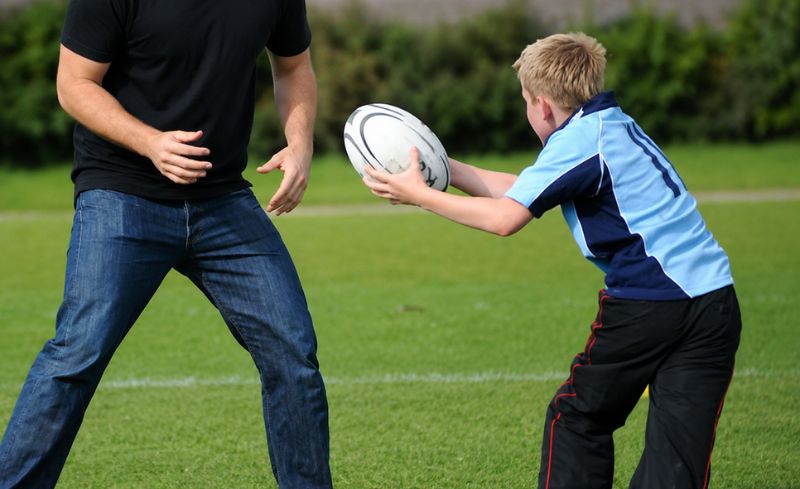
Before your child can pass, run a line, or contribute to a team move, they need to be comfortable receiving the ball. Not just when it comes straight to their chest, but when it arrives high, wide, behind them, or under pressure from a defender. A young player who trusts their hands actively wants the ball.
They call for it under pressure. They position themselves to be an option rather than staying in a space where they hope it will not come to them. That shift from passive to active involvement is one of the most important developments in a junior rugby player’s growth, and it almost always starts with catching confidence. At IBIC Rugby, dedicated time is spent on catching from the very beginning of a player’s development. Progressive drills start simple and build complexity gradually, so every young player develops a solid base before game-like pressure is introduced.
2. The Basic Pass
The rugby pass looks simple from the sideline, but the technique involves rotating the body correctly, positioning the hands properly on the ball, timing the release, following through in the right direction, and passing to where a teammate is going rather than where they are standing. These are skills that take genuine repetition to become natural.
Many young players learn to pass in a technical sense but never fully develop the timing and decision-making that makes passing work in a real game. At IBIC Rugby, the focus goes beyond physical mechanics to the rugby thinking that underlies a good pass. Reading a teammate’s run, understanding when to hold and when to release, and building the communication habits that make moves work are all part of how passing is taught. Individual coaching is uniquely placed to address these skills because every session is shaped around exactly where your child is in their development at that moment.
3. Running Lines
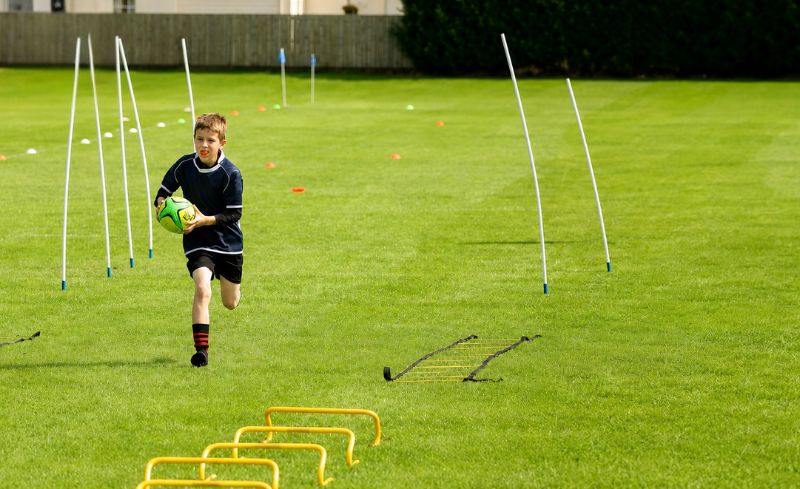
One of the most common things visible in junior rugby at every level from U8 to U12 is young players running in straight lines, chasing the ball carrier, or clustering around contact without any real sense of shape or purpose. This is completely natural at the start. It takes time and coaching to develop the spatial awareness and game understanding that underpins effective running lines.
Understanding how to run at an angle to create space for a teammate, how to hold a defender with a decoy run, and how to time a support line so you arrive at exactly the right moment are concepts that young players can absolutely grasp when taught patiently and progressively with real-time feedback. At IBIC Rugby sessions in Constantia, running lines are introduced through games and movement exercises before they become structured drills, because young players learn spatial concepts most effectively when they are actively playing rather than passively listening to instructions.
4. Body Position in Contact
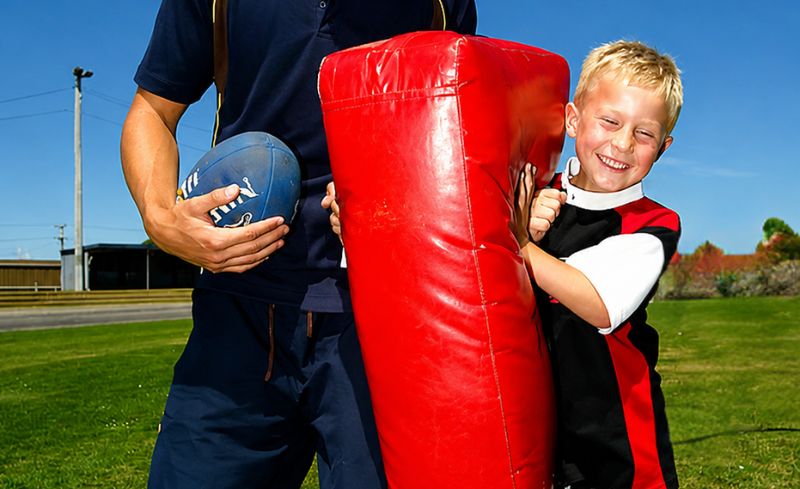
This is the area of junior rugby development where BokSmart principles matter most. Safe body position in contact means low hips, a strong and engaged core, shoulders above hips, and the head positioned safely to the side.
This is not just a technical requirement. It is the physical foundation that protects your child every time they go into a contact situation, whether that is a tackle, a ruck, or a driving maul. At IBIC Rugby, contact is introduced carefully and progressively. No young player moves to the next level of intensity before they have demonstrated genuine comfort and technical correctness at their current level.
Every body position cue is explained with clear reasoning, because a player who understands why they are doing something will maintain that technique under pressure far more reliably than a player who has simply been told what to do. Safety in rugby is built into every session at IBIC Rugby, and BokSmart certification underpins that approach at every level.
5. Spatial Awareness
The players who make the biggest impact in rugby at every level are not always the fastest or the strongest. They are the players who see the field most clearly. Who know where a gap is going to open before it does. Who understand where teammates are, where defenders are, and where the space is, all at the same time.
Spatial awareness is often described as something you either have or you do not, but this is not accurate. It is a skill that develops through deliberate practice, specific coaching, and real-time feedback that is only possible in a small group or one-on-one coaching environment. At IBIC Rugby in Constantia, spatial awareness is developed through movement games, decision-making exercises, and structured scenarios that give young players time to think on their feet. Over time, this builds a mental model of the game that serves them at every level they go on to play.
Why These Five Skills Matter Right Now
These five skills matter so much at the U7 to U10 age group because they are the building blocks on which every other aspect of rugby development depends. A young player who catches confidently, passes with timing and technique, understands where to run, knows how to be safe in contact, and reads the space around them has everything needed to grow into a genuine asset to any team they play in.
The earlier these foundations are built, with individual attention and proper progression, the more natural they become. They stop being things your child has to think about and start being things they simply do. At IBIC Rugby, based at False Bay Rugby Club in Constantia and serving young players across the Southern Suburbs of Cape Town, this is exactly the kind of coaching provided. One-on-one and small-group sessions built entirely around your child, delivered by a BokSmart-certified coach who has played rugby at the highest levels and is committed to helping young players build a genuine foundation in the game.
Book your child’s first session at IBIC Rugby, False Bay Rugby Club, Constantia.